LipidOne - an in-depth and user friendly lipidomic data analysis tool
- Details
Please visit the new version of LipiOne 2.0 at lipidone.eu.
Description
GENERAL DESCRIPTION
 LipidOne, a freely available software that processes lipidomics data to help researchers to find new relationships between lipid profile and the activity of enzymes/genes involved.
LipidOne, automatically highlights all qualitative and quantitative changes in lipid building blocks both among all detected lipid classes and among experimental groups. Thanks to LipiOne, the discovered differences in lipid building blocks can be easily linked to the activity of specific enzyme classes and or gene expression.
CITATION
Please, cite our work as:
Roberto Maria Pellegrino, Matteo Giulietti, Husam B R Alabed, Sandra Buratta, Lorena Urbanelli, Francesco Piva, Carla Emiliani, LipidOne: user-friendly lipidomic data analysis tool for a deeper interpretation in a systems biology scenario, Bioinformatics, 2021; btab867, https://doi.org/10.1093/bioinformatics/btab867
CONTACT
For general questions concerning the use of the software please contact Roberto Maria Pellegrino (This email address is being protected from spambots. You need JavaScript enabled to view it.)
For problems with installation, operation, software compatibility contact Matteo Giulietti (This email address is being protected from spambots. You need JavaScript enabled to view it.)
Download
LipidOne is an executable file that does not require installation. Follow the instructions below and try working with our example datasets.
Instruction:
a) For the first time only, the user must install the Gnuplot graphics libraries. They can be downloaded free of charge from: https://sourceforge.net/projects/gnuplot/files/gnuplot/5.4.2;
b) Download LipidOne and place it in a folder of the user's choice.
c) Double click on the icon to start LipidOne.
*) We would like to thank Dmitry Karasik and colleagues for the development of the Perl Prima library (http://www.prima.eu.org/), which we used for the development of the Graphical User Interface of LipidOne.
**) We also thank Thomas Williams and colleagues for their GNUPLOT graphical library (http://www.gnuplot.info/), useful for the creation of the LipidOne bar graphs.
Dataset
Try and explore some example datasets with LipidOne.
RETINA: Trzeciecka, A. et al. (2019) Comparative lipid profiling dataset of the inflammation-induced optic nerve regeneration. Data in Brief, 2352-3409.
FUNGUS: Lipid profiling of fungus (our internal, unpublished results).
ALGAE: Lipid profiling of algae from Riken Demonstration Files (http://prime.psc.riken.jp/compms/msdial/main.html).
Note: If the lipid annotation of your dataset does not comply with the LSI guidelines*, you can convert your data with LipidLynxX Converter.
---
*) Liebisch,G. et al. (2020) Update on LIPID MAPS classification, nomenclature, and shorthand notation for MS-derived lipid structures. Journal of Lipid Research, 61, 1539-1555.
How to use
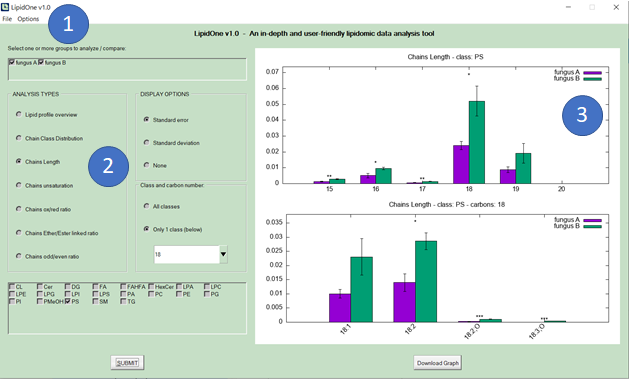 Three-step LipidOne workflow
1) Data upload: the user must select a data matrix (txt or csv tab delimited file) containing the names and concentrations in each lipid sample detected (see example dataset). The accepted lipid nomenclature is the "molecular species level" or "sn-position level" as reported by the Lipidomics Standards Initiative (LSI) Guidelines.
2) Query selection: The user starts to explore the dataset using seven types of analysis and dynamic context-dependent menus.
3) Get results: all graphs and tables can be exported.
Click here to download the quick guide
License
GENERAL STATEMENT
LipidOne is free software: you can redistribute it and/or modify it under the terms of the GNU General Public License as published by the Free Software Foundation, either version 3 of the License, or (at your option) any later version.
DISCLAIMER
LipidOne is distributed in the hope that it will be useful, but WITHOUT ANY WARRANTY; without even the implied warranty of MERCHANTABILITY or FITNESS FOR A PARTICULAR PURPOSE. See the GNU General Public License for more details.
CONTACT
For general questions concerning the use of the software please contact Roberto Maria Pellegrino (This email address is being protected from spambots. You need JavaScript enabled to view it.)
For problems with installation, operation, software compatibility contact Matteo Giulietti (This email address is being protected from spambots. You need JavaScript enabled to view it.)
Teaching Activity – Offerta Formativa Prevista ed Erogata
- Details
XXXVIII cycle - A.A. 2022/23, 2023/24 and 2024/2025 (also valid for XXXVI and XXXVII cycles)
List of the ad-Hoc Courses Offered
List of the scientific Seminars offered for the PhD cycles XXXVIII, XXXVII and XXXVI
Employment opportunities
- Details
The high-level skills obtained during the doctoral course in the field of vital processes related to human well-being and the organism-environment interaction (acquisition of titles such as publications in ISI scientific journals and participation in conferences) will enable participation in public competitions for temporary and permanent positions in national and international academic institutions. Furthermore, the acquired competencies will provide opportunities for employment in research activities within public entities (e.g., CNR, ARPA, ISPRA, zooprophylactic institutes, National Parks), international organizations, and national and international industries.
The advanced training obtained during the PhD course, including project management, problem-solving skills, teamwork, data analysis, etc., will also qualify individuals for managerial or coordinating positions in both public and private companies.
Research Groups
- Details
Biodiversity and Ecology (Prof. Roberto Venanzoni)
Biochemical and Biotechnological Sciences (Prof. Carla Emiliani)
Bio-Molecular Diversity & Evolutionary Biology (Prof. Ines Di Rosa)
Molecular Physiology (Prof. Luigi Catacuzzeno)
Computing, Theory and Experiments of Dynamics and Kinetics Studies for Chemical Processes (Prof. Fernando Pirani)
Molecular Spectroscopy (Prof. Assunta Morresi)
Environmental Chemistry and Technologies (Prof. David Cappelletti)
Catalysis for Energy (Prof. Alceo Macchioni)
Green S.O.C. (Prof. Luigi Vaccaro)
Materials for Artworks' Conservation (Prof. Aldo Romani)
Photophysics and Photochemistry (Prof. Fausto Elisei)
Plant Physiology Lab (Prof. Stefania Pasqualini)
Design, Synthesis and Properties of Compounds with Potential Pharmaceutical Interest (Prof. Gabriele Cruciani)
Theoretical and Computational Inorganic Chemistry (Prof. Filippo De Angelis)
Integrated Physiology and Preclinic (Prof. Bernard Fioretti)
PhD course description
- Details
Among the main challenges that contemporary society faces, the well-being of humans in harmony with the preservation of the natural environment plays a central role, also in relation with the need to preserve the full functionality of ecosystems and ensuring the essential services they provide both in the present and in the future. Within this framework, the Ph.D. program in Biological and Natural Sciences aims to provide in-depth theoretical and practical expertise in the field of life sciences related to humans and the environment. Specifically, the program is structured into two curricula: one focused on studying the key vital processes underlying human well-being and health, such as nutrition, cell communication, inflammation, cellular regeneration, and differentiation (Curriculum: Vital Processes and Human Well-being); the other dedicated to studying the physical, chemical, and biological processes that regulate the interaction of animal and plant organisms with their environment, also with the purpose of providing analytical and intervention tools for the management of conservation issues and the sustainable use of biodiversity (Curriculum: Organism-Environment Interaction).
PhD course aims
The educational and scientific activities included in the program aim to train internationally qualified research doctors capable of independently developing, proposing, and conducting original research projects in the most advanced areas of basic biological and naturalistic disciplines. All of this is done to ensure the well-being of organisms and the functionality of ecosystems, enhancing quality and safety in human-environment interactions.
In particular, the curriculum "Vital Processes and Human Well-being" aims to train young researchers capable of developing and applying innovative and complex methodologies, including biotechnological ones, to address the most advanced aspects of basic biological disciplines. This involves conducting independent and original research supported by the expertise of the teaching staff (doctoral board) of the PhD.
Similarly, the training of Ph.D. students in the "Organism-Environment Interaction" curriculum will enable them to autonomously carry out fundamental or applied research projects in the most advanced fields of animal and plant biology and ecology, as well as in the management and conservation of natural resources. This will be accomplished with the help of the scientific and cultural competencies of the board members of the PhD.
Additional objectives of the Ph.D. program as a whole include:
Promoting collaboration between research institutions, advanced training schools, public and private companies in the field of biological and natural sciences. This is also aimed at facilitating the entry of Ph.D. graduates into leadership and coordination job positions.
Promoting the internationalization of research through mandatory stays abroad for Ph.D. students, establishing and implementing international scientific collaborations, involving foreign teachers, and recruiting non-Italian Ph.D. candidates.
A fundamental and central element of the doctoral training path is involvement in experimental research activities. Ph.D. students will dedicate full time to their research projects, providing critical and active contributions, thereby achieving scientific and managerial autonomy.